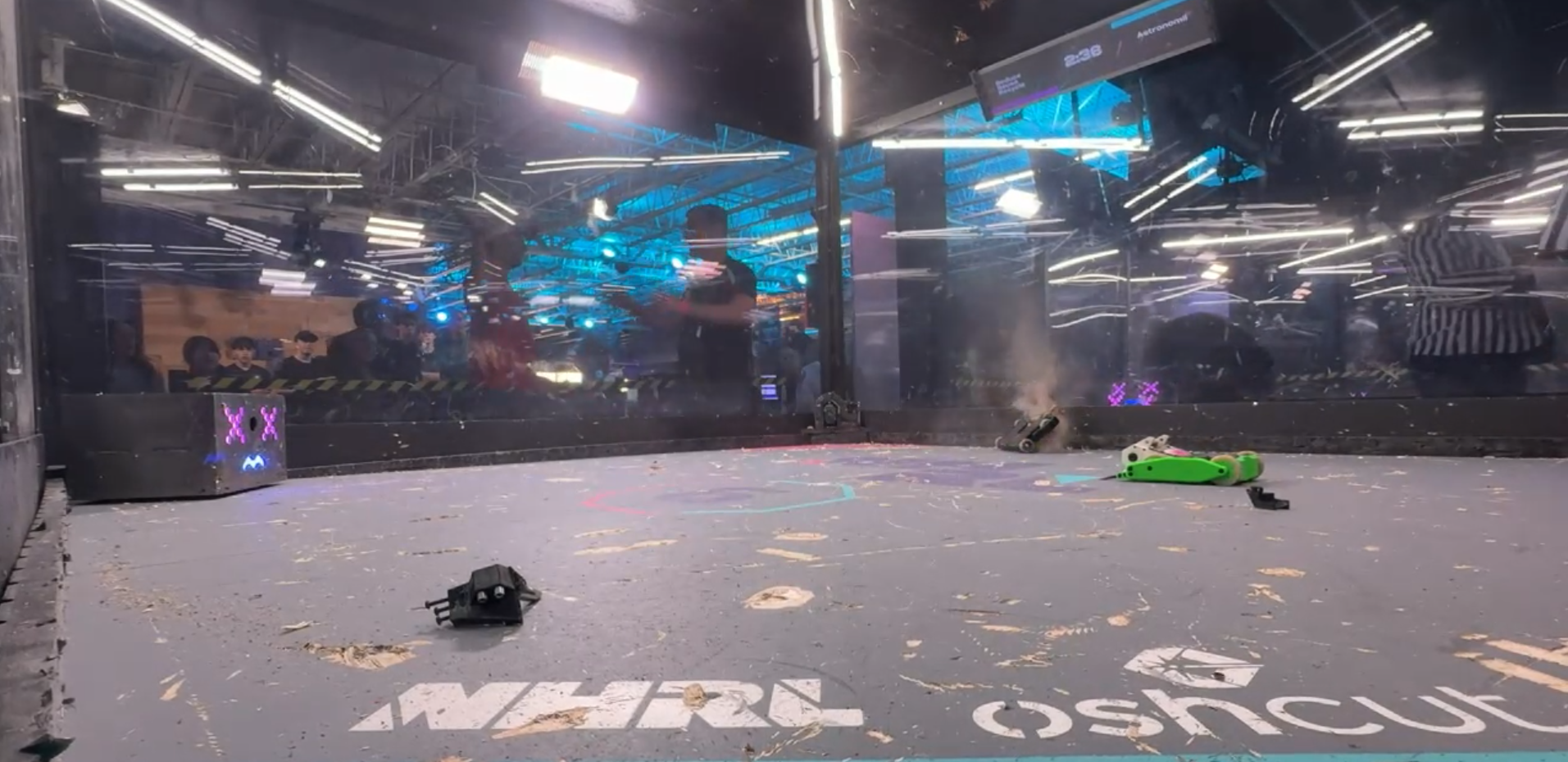
Reduce-Reuse-Recycle v1

3lb Beater Bar Combat Robot

Design Philosophy

The design philosophy of Reduce Reuse Recycle was to create a cheaper battlebot that could be built with minimal machining in preparation for me to finish college, since I will no longer have access to a machine shop. Because of that, reducing the number of new parts as much as possible while also making it simple to repair (such as swapping out the uprights within 10 minutes) were major design requirements. To accomplish this, I 3D printed as many parts as possible. All of the bolts that held the frame together were 10-32, and I machined the remaining custom parts myself to reduce costs as much as possible.

Machining and Setup
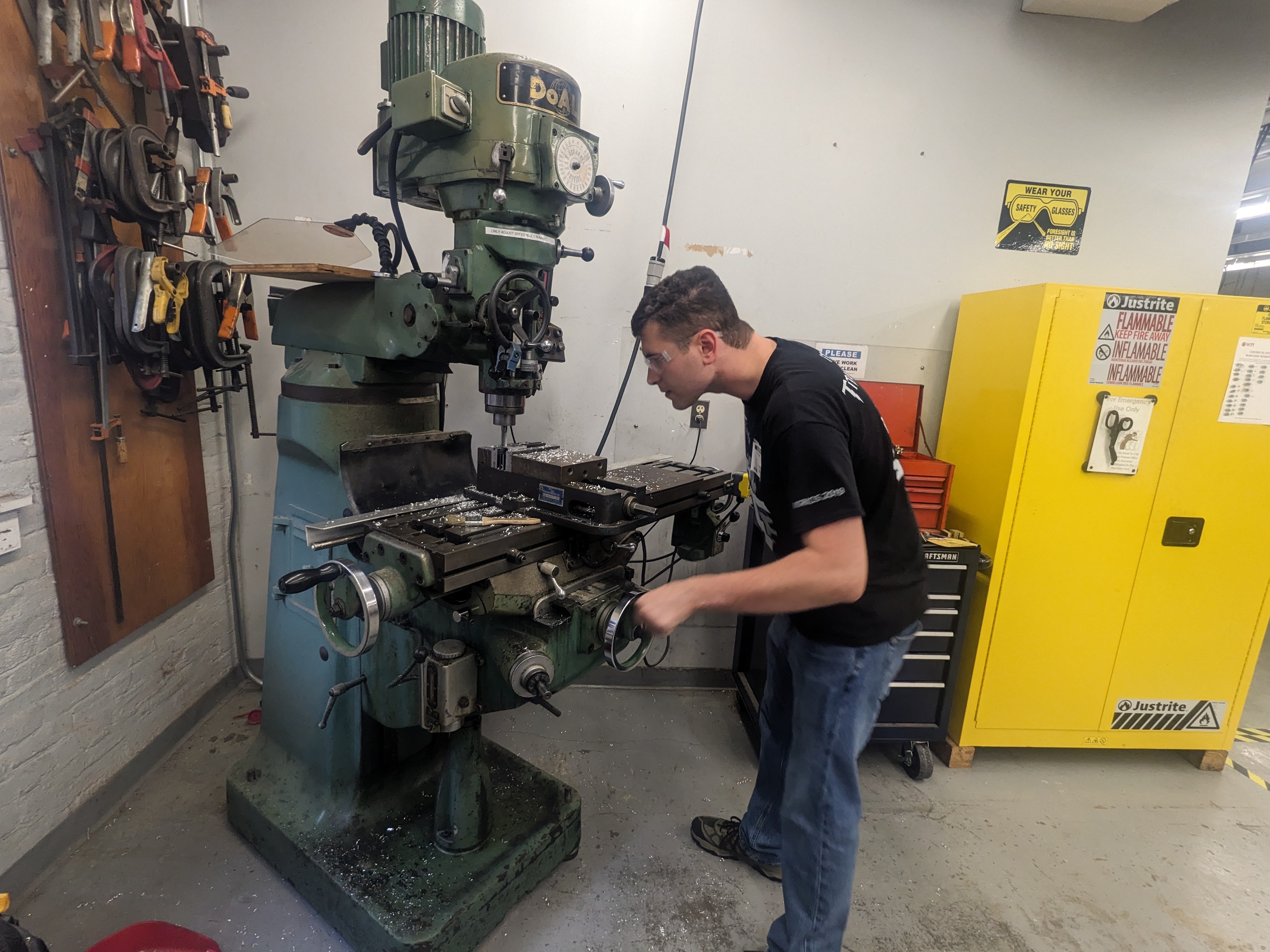
To machine the aluminum parts of the robot, I used a wide variety of machines—from CNC machining complex shapes such as the pulley and the interfacing geometry, to using a manual mill to finish faces that would be difficult to fixture on a CNC machine, to tasks as basic as countersinking with a hand drill. I did all of it, from the CAM programming to the drilling. I learned how to machine using a wide variety of tools, ranging from automated CNC machines to manual lathes and mills.

Performance and Lessons Learned
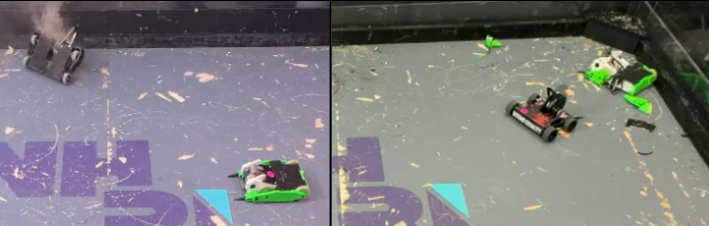
Reduce-Reuse-Recycle v1 has a 2:2 win-loss ratio. During the fights, I learned a lot about the flaws of this robot. While the weapon on the robot is very formidable—being identical to the one used by Very Original—it cannot spin up quickly enough to win the first engagement. A common observation in my fights was very simple: I always lost the first engagement, but if I could mount a comeback, I would win by knocking out my opponent. This means my robot's weapon must spin up faster and that I must win the ground game. If I don't win the first engagement and I face a formidable battlebot like Chainsaw Kitty, they will use it to their advantage, and I will in all likelihood lose the fight. Future iterations of Reduce Reuse Recycle will therefore operate on the principle that the best defense is a good offense, with minimal armor and the remaining weight allocated toward more powerful electronics and a more damaging beater bar.
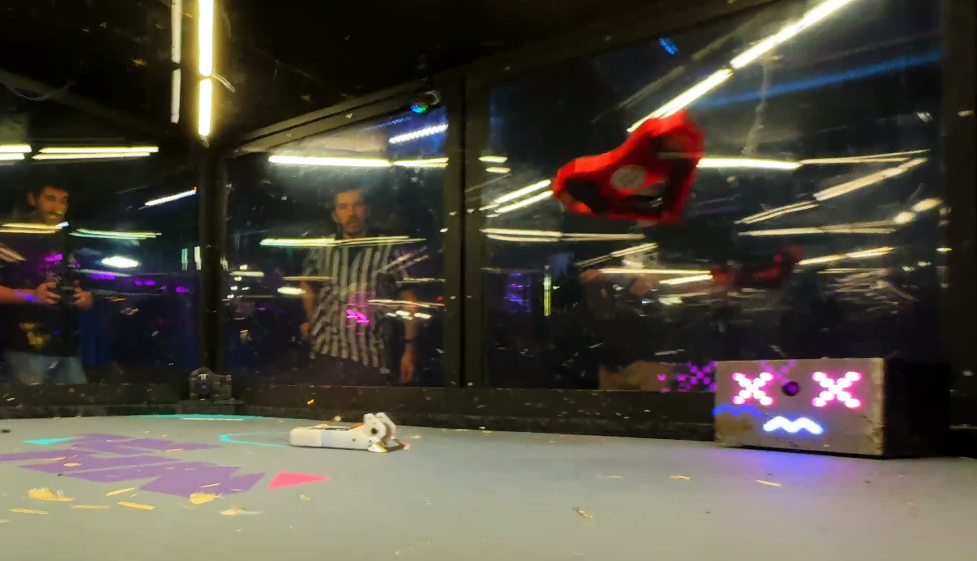
Recorded Fights

Very Original

3lb Beater Bar Combat Robot

Design Philosophy

The design philosophy of Very Original is based on one thing, how can I improve my machining skills. To do this, I minimized the use of all 3D printed parts, having the robot's armor made out of UHMW rather than the standard TPU. I also wanted to try making a 4WD combat robot with a beater bar. The beater bar has a spin up time of 1.5s, as well as having a kinetic energy of roughly 1kJ, for reference the energy needed to launch an opposing 3lb robot to the roof of the arena is roughly 50J. That way if I even get a glancing hit, my opponent gets launched into the air.

There were some issues with the initial construction, due to time constraints, I wasn't able to machine the pulley, rather I had to print it out of glass filled nylon, with the power inherent in the weapon, this caused the pulley to explode after disabling the opponent's weapon. Additionally, the wheels were not designed well, the rubber treads were not thick enough causing it to peel in the arena, and the wheels were difficult to replace. Lastly, the robot wasn't as fast as I wanted it to be, with a top speed of only 11.6m/s.

Recorded Fights

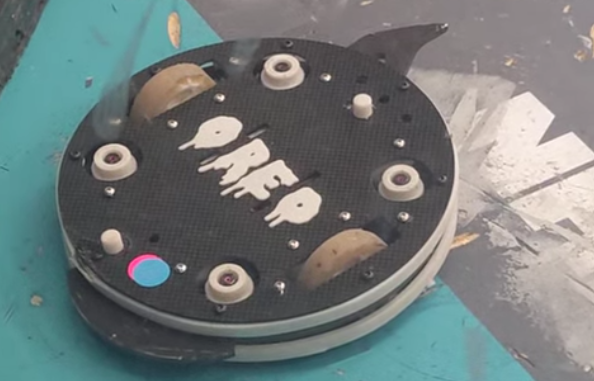
Double Stuffed

3lb Ring-Spinner Combat Robot

Design Philosophy

The design philosophy of Double Stuffed is very simple - how can you maximize the protection of a battlebot? The answer- Make it too dangerous to even touch. As a result, the robot was designed as a ring spinner. A ring spinner is a giant planetary gearbox, with the weapon being the orbiting gear. Through this design philosophy of the weapon being the armor of the robot, the current iteration of Double Stuffed has the weapon being driven by 4 500W motors, which would be the planetary gears, allowing the robot's 1lb weapon to spin up in under 1 second.

The robot was made using 3D printed parts and carbon fiber, using Onshape for the design. The 3D printed parts are made from TPU, and the robot has gone through 9 iterations to get to its current optimized design.

Recorded Fights